Cryptocurrency Exchange Development Services
Mxicoders is a crypto exchange development company that builds custom, white label, and P2P crypto exchange software for founders who need real trading volume, not a demo.


Cryptocurrency Exchange Development Services We Offer
Every business enters the crypto market with a different starting point. Some want full ownership of the code, some want to launch in weeks on proven infrastructure, and some just need a specific module bolted onto what they already run. Here’s how Mxicoders covers each path.
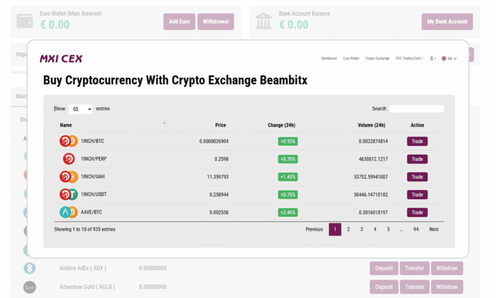
Centralized Exchange (CEX) Development
A matching engine built for speed, hot and cold wallet segregation, and KYC/AML flows designed to pass an audit rather than just look like one.
Decentralized Exchange (DEX) Development
Web3 wallet connect, on chain order books or AMMs, MEV protection, and gasless meta transactions so first time users don’t bounce before their first swap.
P2P Crypto Exchange Development
Escrow smart contracts, dispute resolution workflows, reputation scoring, and local payment rail support built for markets where fiat on ramps are the real bottleneck.
White Label Crypto Exchange Software
Pre built, tested trading infrastructure with your branding on top. Order matching, wallet layer, and admin panel are already solved, so you’re customizing rather than building from zero.
Custom Crypto Exchange Software
A platform built line by line around your specific market, whether that’s spot, margin, futures, or options. No vendor lock in, no borrowed limits.
OTC Crypto Exchange Development
RFQ flows, chat based negotiation, escrow contracts, and fast settlement for institutional size trades that would otherwise wreck the order book with slippage.
Hybrid Exchange Development
Centralized liquidity and onboarding paired with decentralized modules for swaps and token launches, the model most founders are actually choosing in 2026.
Crypto Exchange Consulting
Architecture planning, licensing strategy by jurisdiction, and liquidity sourcing guidance before a single line of code gets written.
Why Choose Us
Choosing between these models usually comes down to three questions: how fast you need to launch, how much control you need over the code, and whether your users expect self custody.
Mxicoders has been building blockchain products for 8+ years, with 500+ projects and 255+ clients across BFSI, real estate, and gaming. On the crypto exchange side specifically, that experience shows up in a few concrete ways.
- We’ve delivered 120+ cryptocurrency exchange projects, including platforms processing $75M+ in trading volume.
- Our flagship centralized exchange build kept 70% of assets in cold storage and reached full deployment in 120 days, not the 9 to 14 months some vendors quote for custom platforms.
- A decentralized exchange we built supports 3 chains (Ethereum, BSC, Polygon) and reports 65% repeat swap volume from returning traders, a sign the liquidity actually held after launch.
- We’re rated 4.9 out of 5 across Clutch, GoodFirms, Google, and Upwork, which spans both enterprise review platforms and freelance marketplace feedback.
- Our team works across centralized, decentralized, hybrid, P2P, and OTC exchange models, so the recommendation you get is based on your market, not on which single product we happen to sell.
- Every build includes jurisdiction aware KYC/AML architecture from day one, rather than bolting compliance on after a regulator asks questions.
Book a Free Consultation
Tell us what you’re building and we’ll map out the right exchange model for your market and budget.
Your information is 100% secure and confidential.

Technologies We Use for Cryptocurrency Exchange Development
Our engineering team builds exchange backends and smart contracts on stacks chosen for throughput and security rather than convenience. Core services run on Ruby on Rails, Python, PHP, and Node.js, paired with dedicated blockchain integration layers for Ethereum, BSC, Polygon, and other major networks depending on the exchange model you need.
For centralized platforms, that means a matching engine tuned for low latency order execution. For decentralized platforms, it means audited smart contracts and subgraph indexing that keeps swap data accurate under load. For P2P platforms, it means escrow logic that releases funds only when every predefined condition is met.

Words of Praise:
What Our Clients Are Saying !

Rupesh Mehta
Founder, DropurCard Inc


Kevin Prince
President, towtm.com


Ron Elias
Owner Manager, London House Photography


Michael Magnusson
CEO, EBANQ


Thomas Guttenberger
CEO, Wazoo Mobile Technologies

Steve Durgin
CEO, SDN Pros

Check Out Related Web Services
01
White Label Crypto Exchange Development
Launch customizable blockchain solutions with secure infrastructure, advanced features, seamless integrations, and flexible branding tailored to your business needs.
02
Crypto Wallet Development
Build secure, user-friendly crypto wallets with multi-chain support, seamless transactions, advanced security, and reliable blockchain integration.
03
Blockchain Consulting
Get expert blockchain guidance on technology selection, architecture, strategy, development, security, and scalable solutions aligned with your business goals.
04
Tokenomics
Design effective tokenomics models with utility planning, token distribution, economic strategies, smart contracts, and sustainable blockchain ecosystems.
Where Our Consulting Work Has Landed
The Rhythm of Blockchain:
Staying Ahead


Have a question? We have got the answers
Can’t find what you’re looking for? Drop us a line and we’d be happy to answer any questions you have.
What do cloud computing services include?
A P2P exchange matches buyers and sellers directly with escrow protection. A CEX holds custody and runs the order book itself, offering faster execution but more regulatory exposure.
Should I choose white label crypto exchange software or a custom build?
White label gets you live in weeks on proven infrastructure. Custom software costs more and takes longer but removes the vendor’s feature ceiling entirely.
What exactly is crypto exchange software?
It’s the combined technology stack behind an exchange: matching engine, wallet layer, KYC/AML workflows, admin panel, and trading interface, either built fresh or licensed as a package.
How long does cryptocurrency exchange development actually take?
White label platforms can launch in 4 to 10 weeks. Fully custom builds with a proprietary matching engine typically run 4 to 9 months depending on scope.
Is P2P crypto exchange development a good fit for emerging markets?
Yes. P2P models sidestep weak banking rails by connecting buyers and sellers directly, which is why platforms like this dominate in regions with limited fiat on ramps.
Do you build exchanges compliant with KYC and AML requirements?
Yes, every exchange we build includes identity verification, transaction monitoring, and jurisdiction specific compliance workflows from the architecture stage, not added afterward.
Can a white label exchange be customized later, or am I locked in?
It depends entirely on the vendor contract. Ask specifically what “customizable” means before signing, since some offer full front end access and others only a logo swap.
How does a crypto exchange development company like Mxicoders generate revenue for clients?
Through trading fees, listing fees, withdrawal charges, staking services, and API access fees, the specific mix depends on whether the platform is CEX, DEX, or P2P.
What blockchain networks do you support for exchange development?
Ethereum, Binance Smart Chain, Polygon, and other major networks, chosen per project based on liquidity needs, transaction cost, and the assets you plan to list.
Why is the crypto exchange market still growing in 2026?
Theglobal cryptocurrency exchange platform market is projected to grow from $41.33 billion in 2026 to $96.62 billion by 2034, driven by rising institutional and retail adoption.
Do you provide post launch support after the exchange goes live?
Yes, ongoing maintenance, security monitoring, and feature updates are included so the platform stays stable and compliant as trading volume and regulations both evolve.
What makes Mxicoders different from other crypto exchange development companies?
Direct experience across CEX, DEX, hybrid, P2P, and OTC models, 120+ delivered exchange projects, and a 4.9 rating across Clutch, GoodFirms, Google, and Upwork.
Get Ready to Start Your Project?
As a crypto exchange development company built around your market, your license, and your liquidity plan, we’re ready when you are.
