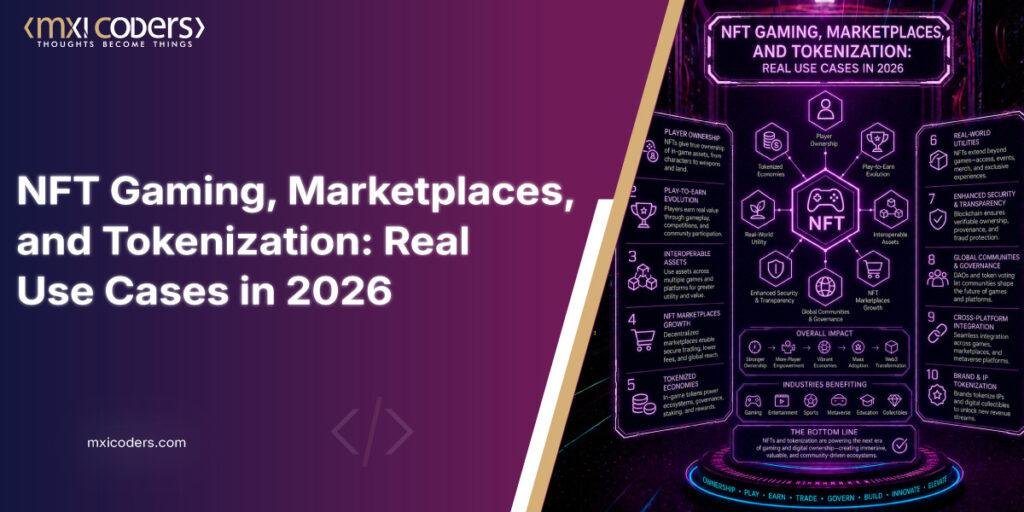
Non fungible tokens are blockchain records that verify unique ownership of a single digital or tokenized real world asset. In 2026 the strongest real use cases are NFT gaming assets, tokenized real estate and funds, ticketing, and music royalties, all traded through an NFT marketplace rather than treated as pure speculative collectibles.
➤ What Are Non Fungible Tokens Actually Used For Today?
A non fungible token isn’t just digital art. It’s a way to attach a verifiable, tamper-resistant ownership record to something that can’t be split into identical, interchangeable units, unlike a coin or a share. That distinction matters because it’s what separates an NFT from a cryptocurrency: one Bitcoin is identical to any other, but one NFT representing a specific in-game sword, or a fractional deed to a specific property, is not interchangeable with any other token. The use cases that have stuck past the 2021 hype cycle share one trait: they attach an NFT to something with ongoing utility rather than a one-time collectible.
➤ Why Has NFT Gaming Become the Largest Use Case?
Gaming is where NFTs found their most durable audience. Players already understand owning a skin or a weapon; an NFT just makes that ownership portable and tradeable outside the game itself. According to Mordor Intelligence’s NFT gaming market report, updated March 4, 2026, the segment is projected to expand from roughly $0.53 trillion in 2025 to $0.62 trillion in 2026, and on to $1.21 trillion by 2031. CoinLaw’s NFT market data, last updated February 6, 2026, puts gaming assets at around a quarter to over a third of all NFT trading volume, one of the largest single categories in the market.
What actually changed in 2026 isn’t the concept, it’s the revenue model. Pure play-to-earn, where a token’s value depended almost entirely on new players joining, has mostly given way to hybrid models where the asset has in-game utility first and secondary market value second.
➤ How Does an NFT Marketplace Actually Work?
An NFT marketplace is the layer that makes ownership tradeable. When a creator mints a token, the marketplace’s smart contract handles the listing, escrow, and, critically, royalty enforcement on resale, so a musician or game studio can keep earning from an asset every time it changes hands, not just on the first sale. This is the mechanism that turns a token from a static file into a rights-management tool, and it’s why a purpose-built marketplace matters more than a generic listing page once volume and royalty complexity grow.
➤ What Is NFT Tokenization, and How Is It Different From a Simple Collectible?
Tokenization takes an existing asset, a building, a fund, a piece of intellectual property, and represents ownership or a claim on it as an on-chain token. It’s a different problem from minting a collectible, because the token now needs to be backed by a legal and custodial structure, not just a blockchain record. According to Forbes reporting from July 2, 2026, major institutions disagree sharply on how big this gets: McKinsey projects $2 trillion in tokenized assets by 2030 excluding stablecoins, Boston Consulting Group estimates $600 billion to $1 trillion in tokenized fund assets under management by the same date, and Standard Chartered’s broader forecast, including trade finance and bonds, reaches $30 trillion by 2034. Real estate is the category most often cited as the next frontier, with fractional ownership lowering the entry point for smaller investors, similar to the shift already underway in NFTs for real estate.
➤ Which NFT Model Fits a Given Project?
| Option | Mechanism | Best fit | Trade-off |
| Single edition NFT (ERC-721) | One unique token per asset | Digital art, one-of-one collectibles | No batch efficiency, higher gas cost per mint |
| Gaming asset NFT (ERC-1155) | Semi-fungible, batched minting | In-game items, skins, weapons | Requires an in-game economy to sustain demand |
| Tokenized real world asset | Fractional token backed by a custody or legal agreement | Real estate, funds, commodities | Needs regulatory and custodial infrastructure, not just a smart contract |
| Music or royalty NFT | Revenue-share smart contract tied to streaming or sales | Independent artists, catalog rights | Value depends entirely on the underlying content’s ongoing performance |
| Ticketing NFT | Single-use token, often burned on entry | Events, concerts | Limited resale utility once the event has passed |
➤ What Are the Biggest Challenges Facing NFT Marketplaces and Tokenization in 2026?
Liquidity is the honest weak point. Research from BeInCrypto, reported by Yahoo Finance in July 2026, tracked around $60 billion in tokenized real world assets across more than 7,000 products, but found that tokenized US Treasuries are the only category that’s reached genuine institutional maturity, with the rest of the market still fragmented across closed platforms that don’t talk to each other. For NFT gaming, the challenge is less about technology and more about retention: a token only holds value if the game or platform behind it keeps its player base active, which is why studios are increasingly building the game economy first and layering NFTs on top, rather than the reverse.
➤ How Much Does It Cost to Build an NFT Marketplace?
There’s no honest single number here, and any page giving you one without sourcing is guessing. Cost depends on a handful of concrete decisions: which chain you build on and its fee structure, whether you need a custody and KYC layer (required for tokenized real world assets, not for most collectibles), how much of the royalty and escrow logic needs custom smart contract work versus off-the-shelf standards, and whether the audit and security review is done by an independent firm before launch. Across the marketplace and tokenization builds I’ve scoped for gaming and real estate clients, the custody and compliance layer, not the smart contract itself, is consistently the part that gets underestimated in early planning. If you’re weighing whether to list on an existing marketplace versus commissioning your own through NFT marketplace development services, that compliance question is usually the deciding factor, not the front-end build.
➤ Limitations, Caveats, and Where the Data Runs Thin
Market sizing for NFTs and tokenization varies enormously depending on which firm you read and what they count. For the 2026 NFT market alone, estimates range from $18.71 billion (Fortune Business Insights) to over $60 billion (CoinLaw), largely because some models include gaming ecosystem value and platform TVL while others measure direct marketplace revenue only. The same split shows up in tokenization forecasts for 2030, where McKinsey’s $2 trillion and BCG’s $16 trillion aren’t really disagreeing about direction, they’re measuring different addressable markets. Treat any single “the NFT market will be worth X” headline with that context in mind.
➤ Conclusion
The use cases that have staying power in 2026 share a common thread: the NFT is doing a job, verifying a gaming asset’s provenance, fractionalizing a property deed, enforcing a royalty split, rather than existing purely as a speculative collectible. NFT gaming remains the largest and most active segment by volume, while tokenization is the slower-moving but structurally larger opportunity, gated less by blockchain technology and more by custody, regulation, and liquidity. Anyone evaluating an NFT marketplace or a tokenization project in 2026 is really evaluating those three things, not the smart contract.
➤ Frequently Asked Questions
- Is NFT gaming still profitable in 2026?
It depends on which side of it you mean. For studios, revenue increasingly comes from a hybrid of asset sales and ongoing marketplace royalties rather than pure play-to-earn payouts, which makes retention, not new player acquisition, the main profitability driver now. - What’s the real difference between an NFT and a tokenized real world asset?
An NFT can exist entirely on-chain with no outside dependency. A tokenized real world asset needs a legal and custodial structure behind it, since the token is only as good as the claim it represents on something that exists off-chain. - Should a business list on an existing NFT marketplace or build its own?
Listing on an established marketplace gets you to market faster but limits control over royalty structure and branding. A custom marketplace makes sense once transaction volume or compliance requirements (like KYC for tokenized assets) justify the additional build.
➤ Which blockchain should an NFT marketplace be built on?
Ethereum still holds the largest share of NFT contract activity, but Polygon and BNB Chain have both been gaining ground on cost and speed, per CoinLaw’s 2026 gaming statistics, so the right choice depends more on your target users’ existing wallets than on any single “best” chain.
➤ Are NFTs still relevant after the 2021 hype cycle collapsed?
Yes, but the composition changed. Pure collectible speculation has cooled, while gaming assets and real world asset tokenization have grown into the categories actually carrying volume in 2026.
➤ Ready to move from concept to a working NFT marketplace or tokenization platform?
Mxicoders builds custom NFT marketplace and tokenization solutions, from smart contract architecture through compliance layers. Get in touch to talk through your project scope.
➤ Sources Used
- Mordor Intelligence, NFT Gaming Market report (Updated March 4, 2026)
- CoinLaw, NFT Market Growth Statistics 2026 (Updated February 6, 2026)
- CoinLaw, Crypto Gaming Statistics 2026 (Updated March 26, 2026)
- Forbes, “The Tokenized Asset Market Is $60 Billion. Most Of It Isn’t Moving” (July 2, 2026)
- Yahoo Finance / BeInCrypto Research, “Reality of RWA Tokenization in 2026” (July 2026)
- Fortune Business Insights, NFT Gaming Market report